 Skip-the-line available
 The History of El Escorial: Philip II's Granite Vow
From the Battle of Saint-Quentin to the Herrerian style — how a vow became the largest Renaissance building in the world.
El Escorial began as a vow. On 10 August 1557 — the feast day of Saint Lawrence — the army of Philip II of Spain won a decisive victory over France at the Battle of Saint-Quentin in Picardy, and the pious king pledged to build a monastery in the saint's honour. Six years later, in 1563, the first stone was laid in the granite foothills of the Sierra de Guadarrama, and by 1584 the largest Renaissance building in the world stood complete: monastery, royal palace, royal pantheon and library fused into a single severe granite mass. This guide traces the building's story — the vow, the gridiron plan that honours Saint Lawrence's martyrdom, the two architects who shaped it, its place at the heart of the Counter-Reformation, and the monks who kept it.
The vow at Saint-Quentin
The Battle of Saint-Quentin was fought on 10 August 1557 near the town of Saint-Quentin in Picardy, northern France — a decisive Habsburg Spanish victory over French forces during the Italian War of 1551–1559. The date mattered enormously to Philip II. Deeply pious, he knew that 10 August is the feast of Saint Lawrence, the Roman deacon martyred, according to Catholic tradition, by being roasted on a gridiron. The coincidence of a great victory on the saint's day read, in Habsburg eyes, as divine endorsement.
In thanksgiving, Philip II vowed to build a monastery dedicated to Saint Lawrence. The commission went out and construction began in 1563 in the Sierra de Guadarrama northwest of Madrid, the granite quarried from the mountains directly behind the chosen site. The whole project — formally the Real Monasterio de San Lorenzo de El Escorial — was conceived simultaneously as a religious house, a dynastic burial place and a seat from which Philip could govern his vast empire in retreat from the bustle of court. It was, in effect, both a votive offering and a working capital of the Spanish monarchy.
The gridiron plan and the Herrerian style
The most celebrated feature of El Escorial's design is its plan: a great rectangle subdivided by internal courts into a grid, with four towers at the corners. The layout is traditionally read as a homage to the gridiron on which Saint Lawrence was martyred — a built commemoration of the vow that founded the place. At the centre sits the Patio de los Reyes and, beyond it, the Basilica, around which the monastery, palace, college and library are arranged.
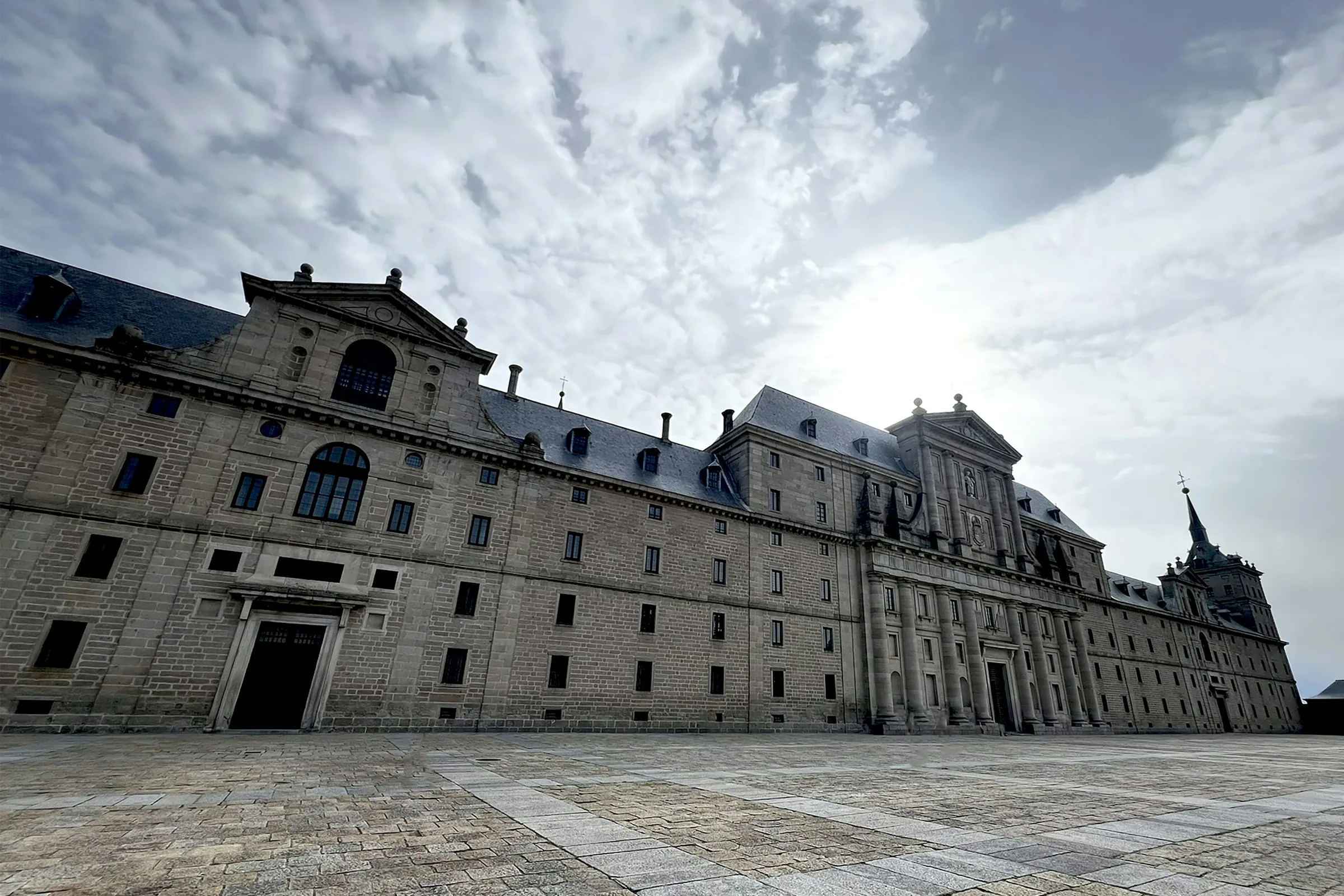
The first architect, Juan Bautista de Toledo, drew the initial plans on Italian Renaissance principles before his death in 1567. Juan de Herrera then took over and gave the building its defining character: a severe, almost wholly unornamented granite finish with long horizontal cornices, plain pilasters and slate roofs that recall the Habsburg north. The style became known as estilo herreriano — the Herrerian style — and dominated Spanish royal architecture for the next century. The result has the bare, monumental presence of a hill fortress rather than a palace, exactly the austere grandeur Philip wanted.
Monastery, palace, pantheon, library
El Escorial was never a single-purpose building. Philip II fused four institutions under one roof. It was a monastery, staffed by a religious order to pray for the souls of the dynasty. It was a royal palace, with apartments from which the king governed — his own quarters placed, with deliberate symbolism, immediately above the Basilica's high altar so that he sat physically over the altar and the pantheon below it.
It was a royal pantheon: a dynastic burial place for the kings of Spain, realised most fully in the octagonal Panteón de los Reyes beneath the high altar, where almost every monarch since Charles V lies. And it was a library — Philip stocked the long upper hall with his own collection and with purchased and confiscated holdings to create one of the great scholarly libraries of the age, frescoed by Tibaldi and furnished with celestial and terrestrial globes. This fusion of prayer, government, burial and learning in one granite complex is what makes El Escorial unique among European royal buildings.
The Counter-Reformation and the monks
El Escorial was built at the height of the Counter-Reformation, and it embodies that movement's spirit in stone. Philip II styled himself the foremost Catholic monarch of Europe, and the monastery was both a personal act of devotion and a public statement of Spain's role as defender of the faith against Protestantism. Its austerity, its scale, its library of theological learning and its pantheon for a Catholic dynasty all served that programme. The complex became a symbol of Habsburg power and Catholic resolve recognised across the continent.
The monastery was first entrusted to the Hieronymite Order (the Order of Saint Jerome), who staffed it from its foundation. In 1885 the Augustinian Order replaced the Hieronymites, and Augustinian friars serve the Basilica to this day. UNESCO inscribed El Escorial as a World Heritage Site in 1984 under the title 'Monastery and Site of the Escurial, Madrid' (inscription 318). The complex remains the property of the Spanish state, managed by Patrimonio Nacional, the public body that administers the Royal Sites of Spain — and it still functions, after more than four centuries, as a living monastery as well as a monument.
Frequently asked
Why was El Escorial built?
Philip II of Spain vowed to build it in thanksgiving after his army's victory over France at the Battle of Saint-Quentin on 10 August 1557 — the feast day of Saint Lawrence, to whom the monastery is dedicated.
When was El Escorial built?
Construction began in 1563 and the complex was substantially complete by 1584 — about twenty-one years for what is still the largest Renaissance building in the world.
Why is El Escorial shaped like a gridiron?
The grid-plan with four corner towers is traditionally read as a homage to the gridiron on which Saint Lawrence was martyred, commemorating the vow that founded the monastery.
Who designed El Escorial?
Juan Bautista de Toledo drew the initial Italian-Renaissance plans before his death in 1567; Juan de Herrera completed the building and gave it the severe granite finish known as the Herrerian style (estilo herreriano).
What is the Herrerian style?
A severe, almost unornamented architectural style — long horizontal cornices, plain pilasters, slate roofs, bare granite — named after Juan de Herrera, that dominated Spanish royal building for a century after El Escorial.
Which monks ran El Escorial?
The Hieronymite Order staffed it from its foundation until 1885, when the Augustinian Order took over. Augustinian friars serve the Basilica today.
When did El Escorial become a UNESCO World Heritage Site?
UNESCO inscribed it in 1984 as 'Monastery and Site of the Escurial, Madrid' (inscription 318). It is managed by Patrimonio Nacional, which administers the Royal Sites of Spain.