 Skip-the-line available
 What to See Inside El Escorial: A Room-by-Room Guide
The Basilica, Royal Library, Pantheon of the Kings, Hall of Battles, Philip II's apartments, the museums and the Courtyard of the Kings.
El Escorial packed four institutions under one granite roof — a monastery, a royal palace, a royal pantheon and one of the great libraries of the Counter-Reformation — and the standard public route walks you through all of them in 90 minutes to three hours. The headline rooms are world-famous: the octagonal marble Pantheon where twenty-six Spanish monarchs lie, and the barrel-vaulted Royal Library with its frescoed ceiling and 40,000 volumes. But the route also takes in the vast Basilica, the 55-metre Hall of Battles, the austere apartments where Philip II died, and a painting collection that runs from Bosch to Velázquez. This guide is the room-by-room order of what to look for, and where the time over-runs happen.
The Basilica and the Courtyard of the Kings
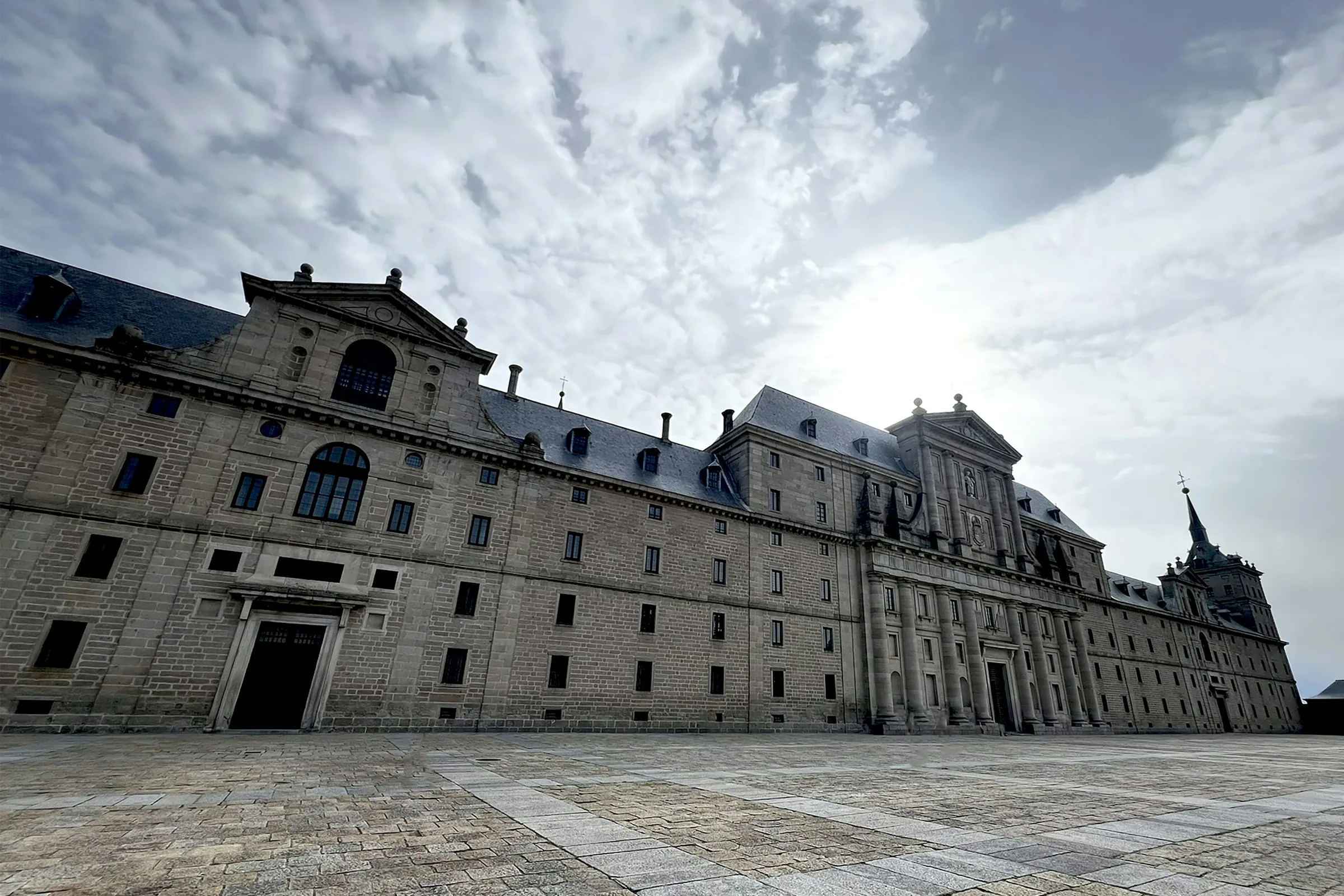
You enter the heart of the complex through the Patio de los Reyes — the Courtyard of the Kings — a vast granite forecourt named for the six statues of Old Testament kings of Judah that line the facade of the Basilica beyond. The austerity is deliberate: Juan de Herrera's estilo herreriano strips away ornament and lets sheer scale and proportion do the work. The courtyard frames the Basilica's twin bell towers and central dome, and it is one of the few interior spaces where photography is permitted.
The Basilica of San Lorenzo el Real is the spiritual centre of El Escorial — a Greek-cross church under a massive granite dome, with Pellegrino Tibaldi's marble-and-jasper high altarpiece rising behind the altar. To either side kneel gilded bronze sculpture groups of the imperial families: Charles V on one flank, Philip II on the other, eternally facing the altar. It remains an active Catholic church, served since 1885 by the Augustinian Order, so dress modestly — shoulders and knees covered — and expect no photography inside. Sunday-morning services can limit access to this part of the route.
The Pantheon of the Kings
Directly beneath the Basilica's high altar lies the Royal Pantheon — the Panteón de los Reyes — an octagonal chamber lined floor to ceiling in dark Toledo marble and serpentine jasper with gilded bronze fittings. Twenty-six near-identical black-marble sarcophagi rest in stacked tiers: kings of Spain on one side, queens whose sons became kings on the other. Almost every Spanish monarch from Charles V through Alfonso XIII is interred here, the principal exceptions being Philip V and Ferdinand VI, who chose burial elsewhere. The chamber was begun under Philip III and Philip IV and its marble revetment finished in 1654 by Giovanni Battista Crescenzi.
A separate and very different space, the nineteenth-century Pantheon of Princes (Panteón de los Infantes), holds the remains of royal children, princes consort and queens whose sons did not reign. It is reached by its own corridor and is consistently quieter than the Pantheon of the Kings. Photography is prohibited in both pantheons. The marble staircase down to the Pantheon of the Kings has no lift and is the single biggest accessibility limitation on the route; staff offer an alternative viewing point for visitors who cannot manage the stairs.
The Royal Library
The Royal Library occupies the long upper hall above the main entrance and is one of the most important historical libraries in Europe. Philip II conceived it as a working scholar's library and stocked it from his own collection and from purchased and confiscated holdings; it now contains roughly 40,000 printed volumes and some 4,700 manuscripts in Arabic, Latin, Greek, Hebrew, Spanish and other languages, with major scientific and theological collections from the Spanish Golden Age. Pellegrino Tibaldi frescoed the barrel-vaulted ceiling between 1586 and 1592 with the seven liberal arts and the Christian virtues.
The public corridor lets you walk the full length of the room past the original Renaissance reading desks, the great celestial and terrestrial globes, and the books themselves — shelved spine-inward, an unusual seventeenth-century inversion designed to protect the gilded page-edges of the bindings. Photography is allowed here without flash or tripods. Scholarly access to the manuscripts requires a separate research application to Patrimonio Nacional and is not part of the visitor route. For many visitors the Library, not the Pantheon, is the room they remember most.
The Hall of Battles and the Royal Apartments
The Hall of Battles (Sala de Batallas) is a gallery roughly 55 metres long, its walls covered in a continuous fresco cycle commissioned by Philip II to commemorate Spanish military victories. The painters — Granello, Castello, Cambiaso and Lazzaro Tavarone — depicted the fifteenth-century Battle of La Higueruela (copied from an older wall-hanging), the Battle of Saint-Quentin that prompted the monastery's foundation, and campaigns in Portugal and the Azores, each scene annotated with inscriptions. It is one of the most spectacular single rooms in the complex and tends to be quieter than the headline spaces.
The Royal Apartments split into two strikingly different worlds. The Habsburg apartments of Philip II, at the east end beside the Basilica, are spare and monastic; the king famously placed his bedroom so that a window opened directly onto the high altar, letting him hear Mass from his bed in his final illness. He died here in 1598. At the north end, the Bourbon apartments redecorated for Charles III and Charles IV are lavish by contrast — tapestries, painted ceilings and eighteenth-century furnishings — and the jump between the two makes the clearest single statement about how Spanish monarchy changed across two centuries.
The museums and the painting collection
The former Chapter Houses (Salas Capitulares), where the monks once held their meetings, now display a serious painting museum. The collection includes work by Titian, Velázquez, El Greco, José de Ribera, Anthony van Dyck, Tintoretto, Veronese, Zurbarán and Hieronymus Bosch — Bosch's Garden of Earthly Delights is associated with the collection when it is not on temporary loan. Photography is prohibited in the painting rooms, where flash damages pigment over time. This is where art-history travellers consistently over-run their time budget.
El Escorial also holds a Museum of Architecture, which documents the building's own construction with original tools, models and drawings, and a Museum of Painting that extends the picture collection. Outside, the Jardín de los Frailes — the Friars' Garden, laid out under Philip II, who was a keen gardener — wraps the south and east of the complex and offers the best ground-level views back at the granite walls. If you have only 90 minutes, prioritise the Basilica, the Pantheon, the Library, the Chapter Houses and Philip II's apartments, and skip the Bourbon rooms; if you have three hours, the museums and the garden reward the extra time.
Frequently asked
What are the main things to see inside El Escorial?
The Basilica, the Royal Pantheon of the Kings, the Royal Library, the Hall of Battles, the apartments of Philip II and the Bourbon kings, the painting collection in the Chapter Houses, and the Courtyard of the Kings.
What is the Pantheon of the Kings?
An octagonal marble-and-jasper chamber beneath the Basilica's high altar holding twenty-six black-marble sarcophagi — almost every Spanish monarch from Charles V to Alfonso XIII, with the exceptions of Philip V and Ferdinand VI.
How big is the Royal Library and can I go in?
The Library holds roughly 40,000 printed volumes and 4,700 manuscripts under Tibaldi's 1586–1592 frescoed ceiling. The public viewing corridor runs the full length of the hall; scholarly access to the manuscripts needs a separate research application.
What is the Hall of Battles?
A roughly 55-metre gallery frescoed with Spanish military victories — including the Battle of Saint-Quentin and the Battle of La Higueruela — commissioned by Philip II and painted by Granello, Castello, Cambiaso and Tavarone.
Which artists are in the El Escorial painting collection?
The Chapter Houses and painting museum hold works by Titian, Velázquez, El Greco, Ribera, Van Dyck, Tintoretto, Veronese, Zurbarán and Hieronymus Bosch, among others.
Where can I take photos inside El Escorial?
Photography is allowed in the courtyards, the gardens, the Royal Palaces and the Library corridor (no flash, no tripods). It is prohibited in the Basilica, both pantheons, and the painting rooms of the Chapter Houses.
How long do I need to see everything inside?
Plan 90 minutes minimum for the standard self-guided route, two hours at an attentive pace, and 2.5–3 hours if you are keen on Habsburg history or the painting collection.